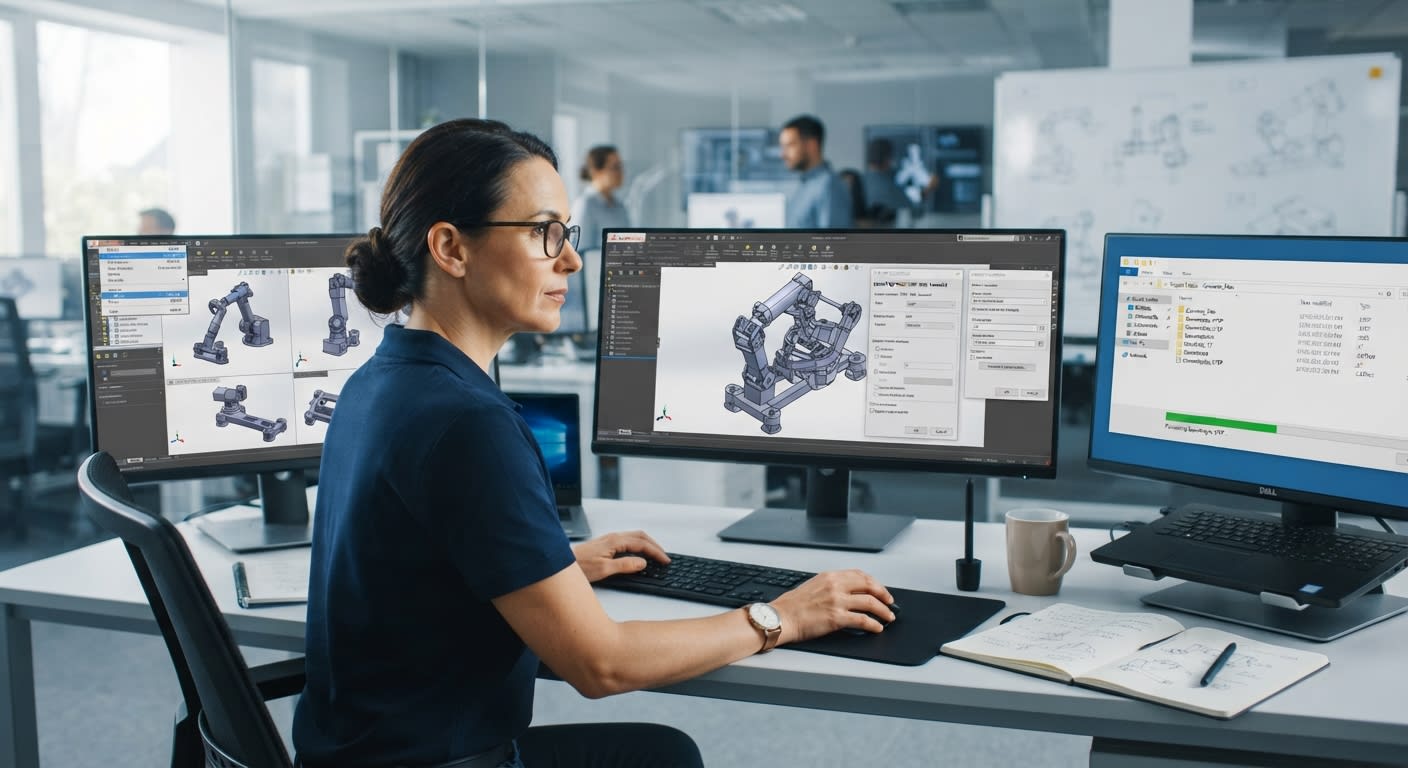
Product development increasingly depends on accurate digital models that can be created, reviewed, modified, and shared throughout the engineering process. Modern 3d engineering software provides tools for working with three-dimensional geometry, assemblies, technical data, and visual representations, helping engineering teams connect different stages of product development.
From early concept development to manufacturing preparation, digital 3D models can provide a common reference for engineers and other project stakeholders. When the software is designed around practical engineering requirements, teams can use these models for design evaluation, collaboration, documentation, and downstream processes.
Supporting Early Design Development
The early stages of product development often involve exploring different concepts and refining ideas. Three-dimensional modeling allows engineers to represent components and assemblies in a more detailed way than traditional two-dimensional approaches.
Designers can inspect shapes, proportions, component relationships, and spatial arrangements before physical prototypes are produced. This can make it easier to identify potential design issues during development and make changes while the project is still flexible.
A digital model can also provide a foundation for later engineering activities, reducing the need to recreate product information at every stage.
Improving Design Review
Engineering teams often need to review models with colleagues from different disciplines. A detailed 3D representation can make technical discussions easier by providing a shared visual reference.
Users can inspect individual components, examine assembly relationships, and focus on specific areas of a design. Visualization capabilities such as rotation, zooming, section views, and measurement can further support technical reviews.
These features can be particularly useful when projects involve complex assemblies that are difficult to understand through individual drawings alone.
Supporting Engineering Collaboration
Product development frequently involves teams working across departments or organizations. Designers, manufacturing engineers, suppliers, analysts, and customers may all need access to relevant model information.
3D engineering applications can support collaboration by providing ways to exchange models and related information between different systems. Compatibility with common engineering formats can be important when project participants use different software platforms.
A structured approach to data exchange can reduce the need to recreate models and help maintain continuity as product information moves between teams.
Connecting Design With Manufacturing
A product model often continues to be useful after the design phase. Manufacturing teams may use engineering data for production planning, tooling, inspection, and other activities.
Reliable model exchange can help manufacturing teams access the geometry they need in compatible applications. Before using converted data for production-related work, however, appropriate validation should be performed to confirm that important geometry and information have transferred correctly.
This helps create a more connected transition from digital design to manufacturing processes.
Managing Complex Assemblies
Modern products can contain hundreds or thousands of individual components. Managing these assemblies efficiently is an important requirement for engineering software.
Users may need to navigate component hierarchies, isolate individual parts, inspect relationships, and review the complete product structure. Efficient model management can make large assemblies easier to work with and can support more productive design reviews.
Performance is also important because large datasets can place significant demands on computer resources.
Supporting Changes Throughout the Lifecycle
Product designs rarely remain unchanged after their initial creation. Components may be modified, materials may change, or manufacturing requirements may evolve.
A useful digital engineering workflow allows teams to update models and distribute relevant information to downstream users. Maintaining organized model data can make it easier to track and communicate these changes.
This continuity can be valuable throughout design, manufacturing, maintenance, and other stages of a product's lifecycle.
Enabling Better Engineering Decisions
A well-developed 3D environment gives engineers access to detailed digital information that can support evaluation and decision-making. Teams can inspect designs, compare alternatives, identify potential conflicts, and review complex assemblies before committing resources to physical production.
The value comes not simply from having a 3D model, but from being able to work with that model efficiently and connect it to the broader engineering workflow.
Conclusion
3D engineering software supports product development by connecting modeling, visualization, collaboration, data exchange, and manufacturing-related workflows. It can provide a common digital foundation for teams working at different stages of a product's lifecycle.
When combined with reliable geometry processing, efficient assembly management, and practical data exchange capabilities, 3D engineering applications can help organizations manage complex product information more effectively. As products become more sophisticated and development processes become increasingly digital, capable 3D software can play an important role in creating connected and efficient engineering workflows.
#CADConverter #C3DConverter



Leave a comment